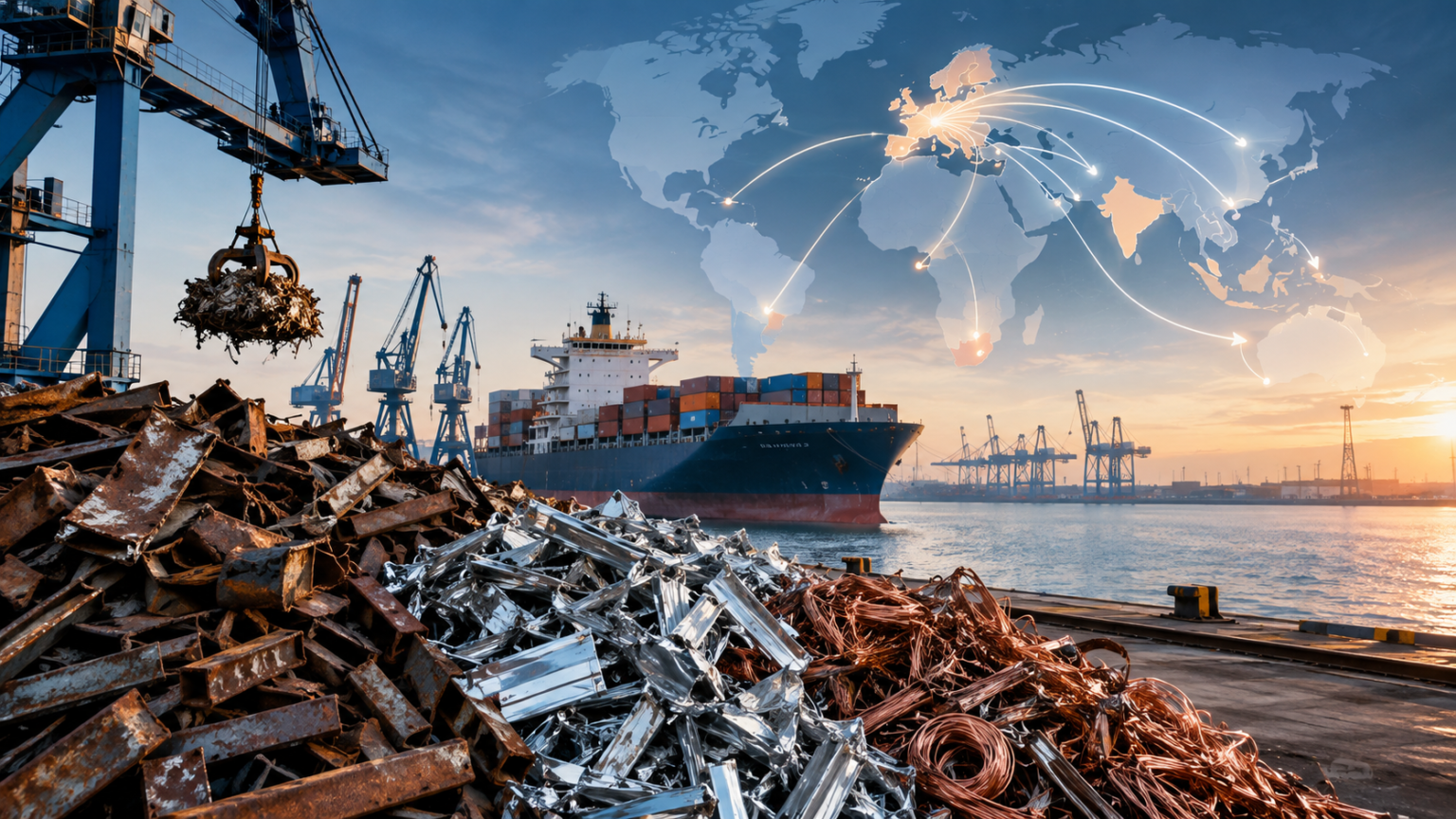
From 21 May 2027, the European Union will introduce stricter rules governing exports of non-hazardous waste—including many ferrous and non-ferrous metal scrap categories—to countries outside the OECD.
Under Regulation (EU) 2024/1157 on shipments of waste, exports to non-OECD countries will generally be prohibited unless the destination country is included in an authorised list established by the European Commission.
This does not automatically mean that all EU scrap exports to every non-OECD country will stop. Authorisation is assessed separately for each country and waste stream.
However, the Commission’s draft list published on 18 September 2026 would currently prevent several major international buyers—including India and Pakistan—from importing metal waste directly from the EU after the new rules take effect. The draft remains subject to consultation and is not yet the final legal text.
The new Waste Shipment Regulation is intended to ensure that waste leaving the European Union is treated under environmentally sound conditions.
A non-OECD country wishing to continue importing EU waste must demonstrate that it has:
India formally requested authorisation for several categories, including metal waste.
In its current draft assessment, the European Commission concluded that India met the requirements for several non-metal waste streams. However, it stated that the information submitted did not sufficiently demonstrate that metal waste would be managed according to the environmental standards required by the regulation.
Consequently, metal waste is not authorised for export from the EU to India under the present draft.
This is commercially significant. India imported approximately 366,000 tonnes of aluminium scrap from the EU in 2025 and was the leading buyer in early 2026. Indian industry representatives have warned that losing direct access to European scrap could tighten supply and raise raw-material costs.
Indian recycling organisations have already requested government intervention, while the Indian Ministry of Commerce and Industry has confirmed that discussions with the EU are continuing. Therefore, the situation should not yet be treated as definitively closed.
Accordingly, EU metal-waste exports to Pakistan would not be authorised from 21 May 2027 if the current draft is adopted without changes.
Pakistan also requested authorisation covering metal waste and several other waste categories.
The draft approves a number of Pakistan’s requested non-metal streams, including certain paper, wood, rubber, textile, mineral, glass and ceramic waste. However, it currently concludes that the country has not demonstrated compliance with the necessary requirements for metal waste.
European exporters and Pakistani importers should therefore avoid assuming that existing trade routes can continue unchanged after May 2027.
No.
The regulation does not create a universal ban on all scrap exports from the European Union.
It creates a stricter system for waste exported to non-OECD countries. Trade with OECD destinations will continue under the applicable shipment rules, while exports to approved non-OECD countries may continue for specifically authorised waste streams.
Material that has legally ceased to be classified as waste may also fall under a different regulatory framework. Nevertheless, the Commission has explicitly warned against classifying waste as a product merely to avoid the Waste Shipment Regulation.
Authorities are expected to monitor attempted circumvention, including onward shipments from an authorised destination to a non-authorised country.
The European Commission opened the draft list for stakeholder feedback on 18 September 2026, with the consultation running until 16 October 2026.
The first definitive list must be established before the new export regime becomes operational. The delegated act is scheduled for adoption during the final quarter of 2026.
The current document explicitly states that it is a draft and does not yet represent the Commission’s final position.
Countries excluded from a particular waste category may:
The list must be updated regularly and at least once every two years. Countries may also be removed if they no longer satisfy the required environmental conditions. EUR-Lex
If India, Pakistan, Malaysia, Thailand and other major Asian destinations remain excluded for metal waste, a substantial volume of European scrap will need new destinations.
The most likely effects include:
European smelters, steel mills and secondary aluminium producers may gain access to volumes previously exported outside the EU.
This could support investments in electric-arc furnaces, aluminium recycling, copper refining and other low-carbon production capacity.
Non-OECD countries that receive authorisation could gain a competitive advantage over excluded countries.
Their access will still depend on specific waste codes, approved facilities, transport costs and commercial conditions.
Companies relying on European ferrous and non-ferrous scrap may need to:
European scrap producers will increasingly need reliable buyers inside the EU or in approved destinations.
This creates opportunities for qualified recycling companies, traders, foundries and industrial consumers able to demonstrate compliance, traceability and recurring demand.
Companies exporting scrap from the EU should begin reviewing their flows now.
Recommended actions include:
Long-term supply agreements should contain provisions covering regulatory changes, unavailable authorisations and alternative destinations.
Exporters should not wait until the first blocked shipment to reorganise their sales network.
Importers wishing to continue purchasing EU scrap should work with their national authorities and industry associations.
They should be ready to demonstrate:
Importers should also communicate their buying requirements clearly to European suppliers, including accepted grades, monthly volumes, ports, inspection conditions and pricing formulas.
The new regime could increase the value of a strong European buying network.
Recovery companies registering on MercatoMetalli can communicate:
When manufacturers request a valuation or publish available material, MercatoMetalli can identify relevant professional buyers.
Under the Commission’s present draft, metal-waste exports to India would not be authorised from 21 May 2027. However, the document is not final, and political and technical discussions are still underway.
Not under the current draft. Pakistan is provisionally accepted for several other waste categories, but not for metal waste.
Potentially yes. The Commission’s assessment expressly considers both ferrous and non-ferrous metal waste. The exact treatment depends on classification and the codes included in the final annex.
It can affect aluminium, copper and other non-ferrous scrap when they are exported as waste to a non-OECD destination that is not authorised for the relevant category.
The specific authorised-country system discussed in this article concerns non-OECD countries. Exports to OECD destinations remain possible subject to the applicable EU and international shipment procedures.
Not by itself. Annex VII may apply to certain green-listed shipments, but the exporter must first establish that the destination country and waste stream are legally eligible and that the receiving facility is authorised.
Yes. The list will be reviewed regularly and at least every two years. Countries may submit new information and request inclusion during later updates.
The new EU Waste Shipment Regulation will not simply add another document to international scrap transactions. It may redraw the routes through which European metal scrap moves around the world.
India and Pakistan are currently excluded from receiving EU metal waste under the Commission’s draft, while some European-neighbourhood countries could retain access for specified streams.
The final outcome is still evolving. Exporters, importers, recyclers and metal-consuming industries should monitor the definitive list and start preparing alternative supply and sales channels well before 21 May 2027.
MercatoMetalli will continue updating this guide as the European Commission adopts the final delegated act and publishes further implementation details.
Last updated: 29 September 2026
Disclaimer: This article provides general market and regulatory information and does not replace legal or environmental-compliance advice.
La registrazione è gratuita e riservata alle aziende.